
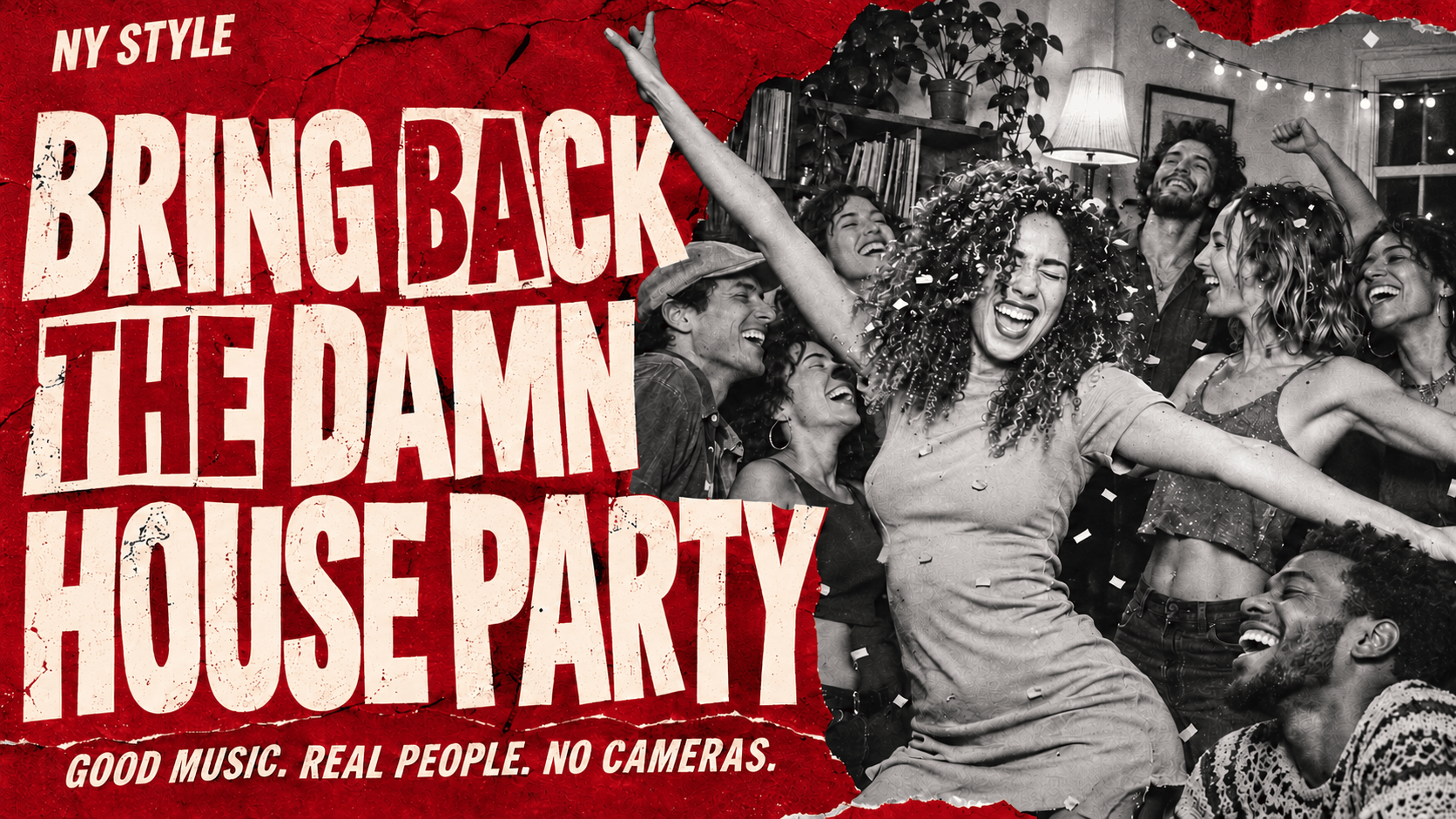
Going out costs a fortune. Staying in got lonely. Somebody move the damn couch.
You should be able to dance like an idiot without waking up as a stranger’s content. That used to be a fairly modest expectation. Now a night out can come with a cover charge, a punishing bar tab, and an unpaid supporting role in somebody’s TikTok. We’ve made letting loose feel like an expensive audition. I would like to propose a radical alternative: somebody put on some music and open the damn door.
Growing up, I remember neighborhood places where people gathered without turning the evening into a major production. House parties. Local clubs. Garage bars. Some operated in that murky territory between a social gathering and a business. What sticks with me is how close they were, how familiar they felt, and how little ceremony it took to get people together.
We need that ease again. A place where you recognize faces, someone notices when you’ve been missing, and hanging around doesn’t require ordering another round.
That is what the conversation about “third spaces” ought to mean. Somewhere beyond work and home where a social life can develop through repeated, ordinary contact. A house party is still somebody’s home, technically, but for the people arriving, it can do some of the same work: give them somewhere to belong.
We Deserve Somewhere To Dance Badly Without Becoming Content
There is a difference between agreeing to go out and agreeing to be published.
Maybe you want to loosen your tie, sing the wrong lyrics, or attempt a dance your knees stopped authorizing in 2011. You should be able to enjoy the room without constantly checking who has a lens pointed at you.
For younger adults whose school years, relationships, and awkward phases have often unfolded alongside social media, an evening without an audience beyond the people present has an obvious appeal. You get to try being yourself without also managing the footage.
Some venues already understand this. New York’s Nowadays prohibits phone use and photography on and around its dance floor, directing guests elsewhere in the venue when they need their phones. Its policy also addresses harassment and consent, with staff available when guests feel unsafe. Privacy works best alongside people taking responsibility for the room. Nowadays
A house party or neighborhood club could adopt the same principle: ask before photographing anyone, keep cameras off the dance floor, and provide somewhere to make a call. Hosts need to follow those rules, too. Advertising a private atmosphere and then uploading a promotional reel of the guests defeats the promise.

A few agreed-upon pictures at the end? Fine. An evening spent dodging somebody’s documentary? Exhausting.
Before Bottle Service, There Was a Bottle in a Grocery Bag
BYOB has a wonderfully unglamorous efficiency. You bring something you enjoy at a price you already understand.
Chicago’s Birch Road shows how that idea can support a continuing social space. Its Lincoln Park clubhouse combines daytime coworking with evening gatherings, personal bottle storage, coffee, and member events. Membership starts at $145 a month. The space supplies the setting; members bring their own alcohol. Birch Road Clubhouse
That price will make sense to some people and remain out of reach for others. It is proof of a business model, not proof that we have solved affordable social life.
Still, the arrangement asks an interesting question: what happens when a venue earns its money from providing somewhere to spend time, rather than from every additional drink?

There could be room for smaller neighborhood versions, shared venues, and regular gatherings in existing cafés or community halls. Those are possibilities to test locally, with the appropriate permissions. The goal should be an operating model that lets people return often enough to know one another.
And the person bringing sparkling water should feel just as welcome as the person carrying bourbon. A bottle can contribute to a party. It should never be the admission requirement for friendship.
Put the Coffee On. Give the Neighborhood Somewhere to Land.
The daytime version might be even easier to love.
Imagine a regular Saturday coffee morning. Some chairs, something to eat, and an invitation that doesn’t require a birthday, a promotion, or an impending wedding. Come by. Stay a while. Meet the person who lives three doors down.
Montreal’s Saturday Cafe began in February 2024 with friends gathering in an apartment. Its founders describe turning the home into a monthly café, then growing into a wider community through pop-ups and events. The project also offers a mobile coffee cart. An ordinary social ritual developed into something people wanted elsewhere. saturdaycafe.com

That is a useful lesson for would-be hosts: start with an occasion people enjoy returning to. Matching ceramics can wait.
Eventbrite’s 2026 Social Study offers some support for this approach. Its survey of 4,051 people ages 18–35 in the United States and United Kingdom found that 58 percent preferred gatherings where socializing wasn’t the main focus. The sample includes both Gen Z and millennials; it should not be read as a verdict on an entire generation. But it suggests that shared activities can make connection less demanding. Event Trends & Insights
Coffee gives you something to do with your hands. A card game gives conversation somewhere to start. Listening to records lets a quiet person participate without delivering an introductory speech.
We could use more invitations that don’t feel like homework.
The Rent Was Due, and The Neighborhood Came Through
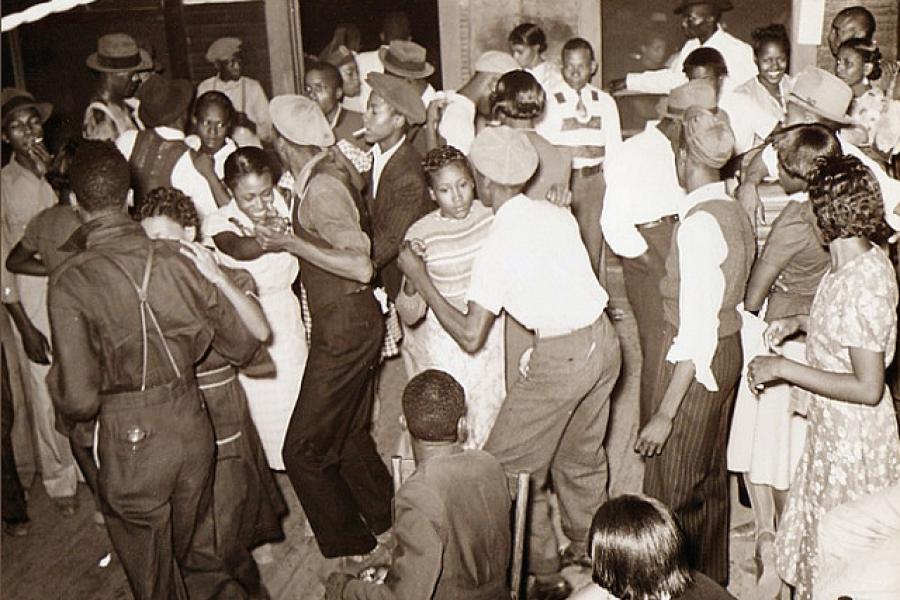
There is history behind turning a home into a social resource.
During the Harlem Renaissance, Black residents facing unequal housing costs and low wages held rent parties to help pay their landlords. Langston Hughes preserved invitations to these gatherings, leaving a record of people making pleasure and mutual support out of difficult circumstances. Langston Hughes
Somebody had rent due. Everybody else had somewhere to be Saturday night.
That history deserves more respect than a cute theme and a vintage flyer. The financial pressure was real. So was the resourcefulness of people who gathered, entertained one another, and helped keep a household afloat.
A modern revival can take inspiration from that sense of shared responsibility. Bring food. Help clean up. Contribute to agreed costs where lawful. Give the host a night off occasionally. Hospitality becomes a lot less sustainable when one person provides the room, pays for everything, and spends Sunday removing mystery liquids from the furniture.
Open the Door—and Read the Rules
There are lawful openings for these ideas, including some recent changes. There are also real limits. A private party, a permitted public event, and a recurring commercial club are different operations.

Los Angeles County’s Microenterprise Home Kitchen Operation program, or MEHKO, is a particularly useful development. It allows permitted residents to run small home food businesses, including on-site dining. The county currently lists limits of 30 meals a day, 90 a week, and $100,000 in annual gross sales. Public-health permitting and operating requirements apply. Department of Economic Opportunity
For an aspiring young cook, that could provide a smaller starting point than a full restaurant. For guests, it creates an opportunity to eat in a more personal setting. It does not turn a home food permit into permission to operate a bar.
New York has opened a different door with its for-profit private-club liquor category. The law requires at least 100 bona fide members and sets an annual license fee of $20,000. Members maintain their status through annual dues. NYSenate.gov
Twenty thousand dollars before you have paid rent or bought a chair puts a certain strain on the word “neighborhood.” It is a formal pathway, but the price raises a fair policy question: how do we make room for modest community businesses alongside well-funded membership clubs?
In Quebec, an accessory alcohol permit can support a social or cultural operation where alcohol is secondary to the main activity. An occasional “to serve” permit offers another route, including BYOB; when admission is charged under that permit, only guests’ own alcohol is authorized. These are specific permissions, not a general membership loophole. racj.gouv.qc.ca

Toronto offers a newer outdoor possibility. Since April 30, 2026, applicants can pursue permits for qualifying public BYOB events at ground level, with the city required to recognize them as cultural or community events. That could support neighborhood gatherings beyond the conventional bar setting. It is not permission for an ongoing indoor garage club. City of Toronto
Home cafés also face different rules from city to city. New York City’s health code generally prohibits food-service establishments in private homes and apartments. Toronto’s ordinary home-occupation rules restrict direct goods sales and many customer visits. A successful apartment gathering in one jurisdiction is not a ready-made operating permit somewhere else. codelibrary.amlegal.com
The useful innovation is a clear, proportionate route that makes a small gathering business possible. Before taking payments, prospective operators need to establish what their property and permits actually allow. Renaming a drinks charge a “club fee” will not settle that question.
Open the Door. Let Strangers Become Regulars.
For Gen Z, the opportunity goes beyond finding a cheaper Friday.
These spaces could offer practice at adult friendship: arriving alone, introducing someone, disagreeing without blocking them, and turning up again next week. A regular gathering gives relationships time to develop beyond a promising conversation and an Instagram follow.

There are creative and business opportunities, too. A permitted home meal can give a cook a place to begin. An appropriately licensed venue can host a small music night. A café can lend its quieter hours to a reading group or game night. None requires promising to become the next enormous thing.
People without a spare living room should be part of this revival. So should renters, nondrinkers, and the friend who needs an accessible entrance. A neighborhood gathering earns its value through who can actually attend.
Keep the invitation manageable. Make the expectations clear. Give people something to do and the freedom to sit a round out. Put the phones away for a while.
Somewhere in that room, a stranger might become the person you look forward to seeing next Saturday.
Somebody move the damn couch.












+ There are no comments
Add yours