

My first impression: Will it eventually kill you—Yes! But will it impress your friends and help you bag a supermodel—Definitely!
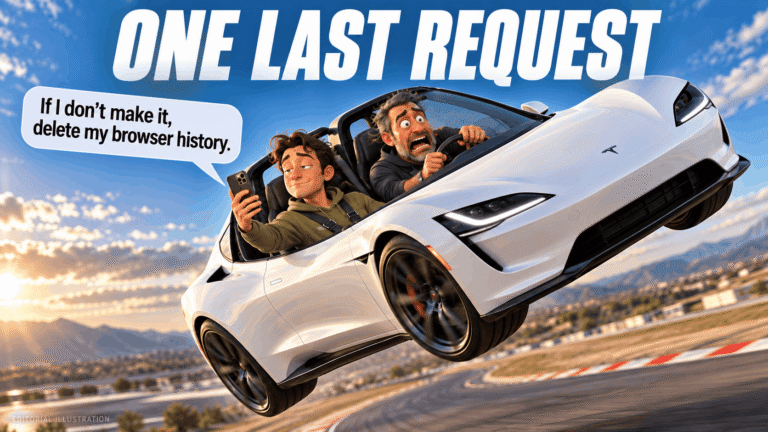
The new Tesla Roadster, “Bro, this thing jumps and flips. I don’t care if you can afford it—can you keep your lunch down and your soul intact?”
There was a time when buying a sports car meant wanting the wind in your hair. Tesla seems to have interpreted that as not enough for the Top Gun generation. Why settle for wind when you could briefly have the entire road above your head?
At its October 15 demonstration, Tesla showed its new Roadster climbing an inverted ramp, leaving the surface and using thrusters to return to the ground. Another maneuver sent it over a lineup of vehicles while performing a midair flip. Somewhere, a Fast & Furious screenwriter watched this and whispered, “We’ve been too conservative.”
Spectacular? Hell Yeah!

Would I like to experience it immediately after brunch? That depends on whether Tesla considers scrambled eggs a warranty exclusion.
Your Stomach Has Questions
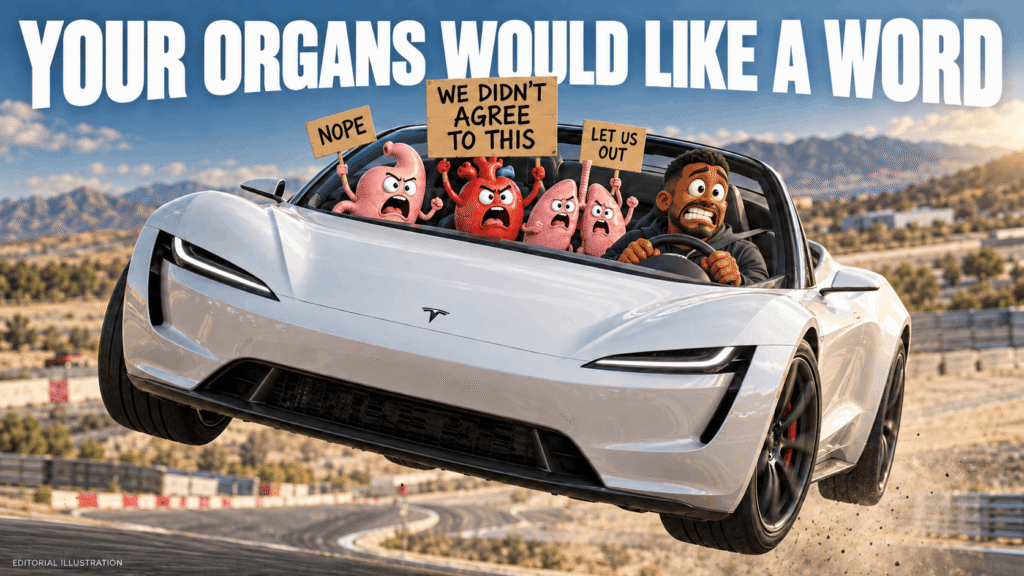
Watching a car turn upside down naturally raises a concern: Could a person survive the G-forces?
Potentially, yes. But the demonstration alone cannot establish that the maneuver would be safe for an occupant.
A flip is not automatically a death sentence. Aerobatic aircraft already rotate people through the sky. What matters is how quickly the vehicle accelerates, which direction the forces act on the body, how abruptly they arrive, how long they last and how well the occupant is supported. NASA’s acceleration standards explicitly account for direction, duration and restraints.
In other words, “It did a flip” is a description of the entertainment. It is not a medical report.

And one detail for me is particularly relevant – the information reported that the demonstration vehicle operated without a human aboard because of the cold-gas thrusters’ noise and vibration. We watched the machine complete the trick. We did not watch a passenger emerge and announce that their spine thoroughly enjoyed the experience.
Zero to Sixty, Followed by a Personal Inventory
Tesla demonstrated a claimed 0–60 mph run of 0.81 seconds. MotorTrend noted that the surface, tires and timing treatment—including whether rollout was used—were unclear. I’m treating it as a demonstration result awaiting independent verification.
Still, the arithmetic is wild!
If a car genuinely goes from a standstill to 60 mph in 0.81 seconds, its average forward acceleration is approximately 3.4 g. That calculation describes the straight-line launch; it does not reveal the forces during the jump or roll, and the peak acceleration could differ.
Your seat would be working very hard to introduce itself to your back.
But that number does not mean you automatically black out. Direction matters. Acceleration pressing a supported torso into a seat differs from acceleration driving blood away from the brain toward the feet. The FAA explains that the latter can cause narrowing vision, gray-out, blackout and unconsciousness.
Thank God the Tesla can drive itself. You and that supermodel crashing into a ditch is not a good look unless you’re a famous actor who needs some headlines.
The Landing Deserves Its Own Publicist
The airborne portion gets the applause. The landing deserves the questions.
A controlled descent that spreads the slowdown over time is very different from an abrupt stop. NASA research identifies restraints, acceleration direction, onset rate and duration as central factors in tolerating rapidly applied loads.
Then add rotation. Where is your head positioned? How is your torso held? What happens if a thruster underperforms halfway through the maneuver?

Those are engineering questions requiring measurements and testing. A video cannot supply the missing occupant-load data, however many times we replay it with our mouths open.
I grew up watching movies convince us that the future would include flying cars. Apparently, nobody thought to ask whether the future would also include a chiropractor on retainer.
A Flying Car Still Has to Become a Car
Tesla says consumer production is planned for 2028, and its airborne “Rocket” configuration is not approved for public-road use. So your morning commute is not about to become an audition for Top Gun.
For now, the Roadster is an extraordinary demonstration with a substantial human question still attached.
Could a properly restrained person survive a carefully controlled jump and roll? Potentially. Has this demonstration established that the maneuver is safe for ordinary customers? No.

I want the future to be exciting. I also want to arrive at dinner with my organs maintaining their original seating arrangements.
Tesla has shown us a car that can flip. Next, show us the evidence that the passenger can remain a satisfied customer.






+ There are no comments
Add yours