
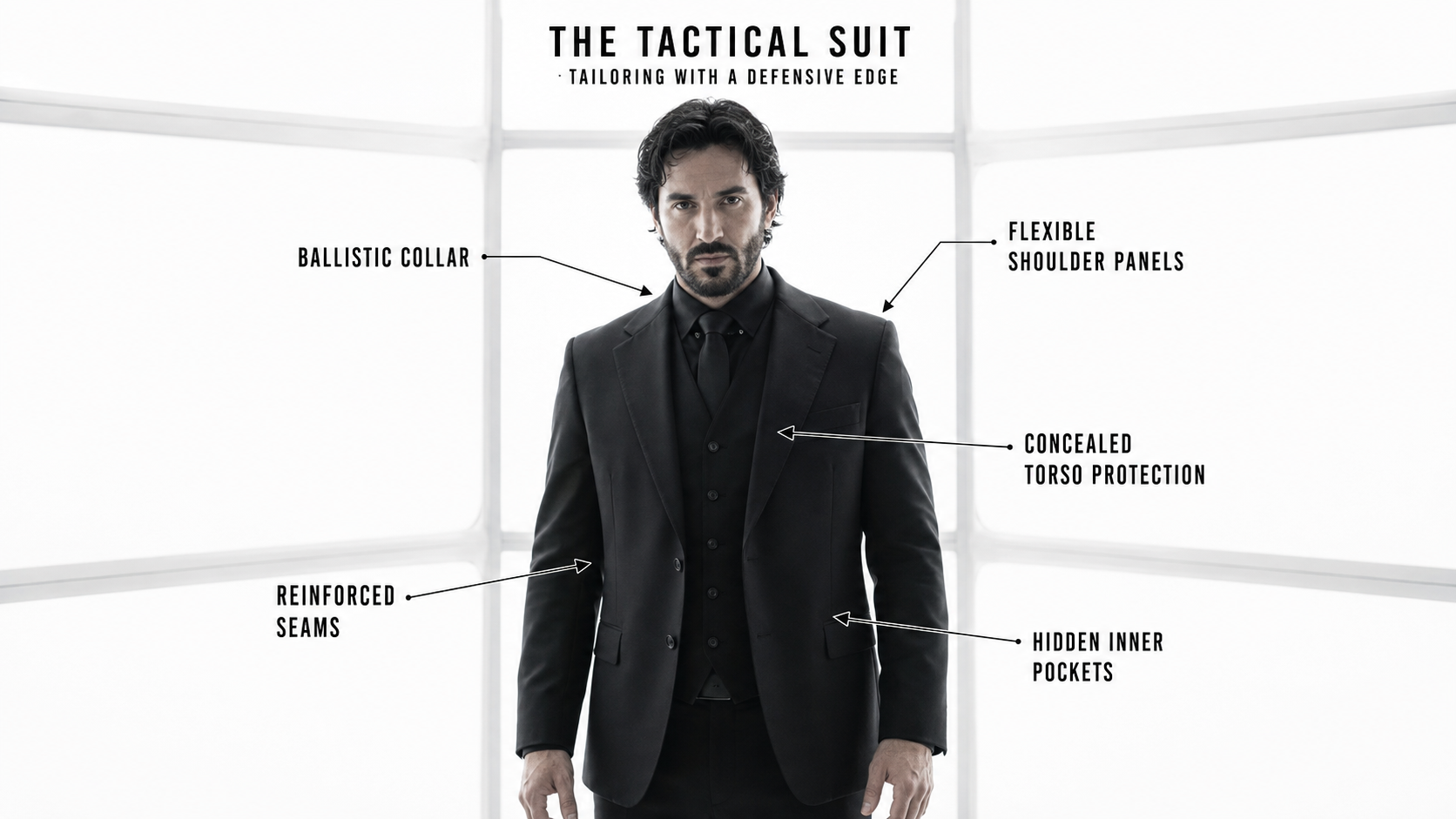


A beautifully tailored suit that offers discreet ballistic protection sounds like Hollywood fantasy. But much of the technology needed to create one already exists.
Let’s begin with the good news: we could build a real-world version of John Wick’s suit.
No, it probably wouldn’t allow you to get shot repeatedly, fall from a building, tumble down several flights of stairs and still make your dinner reservation. That particular feature appears to be available only with a supporting-actor contract and extremely forgiving health insurance.
But a sophisticated black suit capable of providing meaningful protection against certain handgun threats? That is no longer a ridiculous idea.
Modern ballistic fibers are lighter, thinner and more flexible than the bulky body armor most of us imagine. Materials such as Kevlar are designed to catch a projectile while absorbing and distributing its energy. Newer generations of aramid fiber are being developed specifically to improve flexibility, comfort and mobility. In other words, the first part of the John Wick equation—concealing protection inside wearable clothing—is already possible. DuPont describes how Kevlar works and has introduced newer fibers intended to make soft armor lighter and more pliable. DuPont Kevlar EXO
The challenge is making that protection look like it belongs at a five-star restaurant instead of a police equipment locker.
Building the Wick Suit
A proposed John Wick suit would begin with flexible ballistic panels positioned around the chest, back and sides. Instead of simply sewing heavy material into an ordinary jacket, designers would have to treat the suit as a piece of wearable engineering.
The panels would need to remain in place while the wearer ran, turned, reached and performed whatever urgent business required him to enter a nightclub through the least convenient door. The shoulders and elbows would require more flexible construction, while the jacket’s internal structure would have to distribute the additional weight without sagging.
A breathable, moisture-managing lining would also be essential. Ballistic protection tends to trap heat, and nothing destroys the silent-assassin mystique faster than visibly overheating beside the shrimp cocktail.
The trousers could contain limited protective sections around the thighs and hips, although every additional panel would reduce flexibility. A waistcoat or overcoat could provide greater coverage without forcing one garment to do everything. Removable inserts might even allow the wearer to convert the outfit from protected formalwear to an ordinary business suit.
From across the room, it could look elegant, understated and expensive. Up close, it would be a complicated system of tailoring, technical fibers, reinforcement and carefully controlled compromises.
This Is Where the $500 Suit Meets the $5,000 Suit
A $500 suit and a $5,000 suit can look remarkably similar while hanging on a rack. Both may be black. Both may have two buttons. Both can make a man stand in front of a mirror and briefly believe he owns a vineyard.
The difference is usually found beneath the surface.
Many moderately priced suits use fused construction, in which internal material is bonded to the outer fabric. A more expensive suit may use a full-canvas interior that is stitched into place and gradually conforms to the wearer’s body. Premium tailoring can also include extensive handwork, carefully matched patterns, better linings, more precise shaping and numerous fittings.
Of course, an expensive label alone guarantees very little. A properly altered $500 suit can look considerably better than a $5,000 suit that fits like it was borrowed from someone’s taller uncle.
For the John Wick suit, however, high-level tailoring would serve a purpose beyond luxury. The tailor would be responsible for controlling the armor’s position, balancing its weight and preserving the clean line of the jacket. Standard factory sizing wouldn’t be enough. Every panel would have to correspond with the wearer’s measurements and movement.
This wouldn’t simply be bespoke menswear. It would be bespoke menswear after receiving a government research grant.
Looking Elegant Is Only Half the Job
The finest wool has a natural drape. It falls smoothly across the body and moves without looking stiff. Ballistic material has other priorities. Its main concern is keeping an extremely fast piece of metal from continuing its travel plans.
Combining the two would create tension between appearance and protection. More layers could provide protection against a greater range of threats, but they would also add thickness, weight and heat. Lighter construction would look more natural and allow better movement, but it would offer less coverage.
That means a credible Wick suit would probably be designed around soft armor and specific handgun threats—not rifle fire. The National Institute of Justice explains that soft body armor is generally intended for handgun protection, while rifle protection typically requires less flexible hard components. It also emphasizes that there is no such thing as truly “bulletproof” armor; protection depends on the armor’s tested level and the threat it encounters. National Institute of Justice
That distinction matters. A suit should never be marketed as universally bulletproof simply because someone slipped ballistic fabric into the lining. A real protective garment would need to be designed and independently tested as a complete system.
Stopping the Bullet Doesn’t Stop the Physics
Here is where the movie version becomes considerably more generous.
Even when armor prevents a bullet from penetrating, the wearer still receives the force of the impact. Ballistic armor is designed to reduce both penetration and the blunt trauma associated with a strike, but it cannot make the energy disappear.
A protected person may still suffer severe bruising or other injury. He is unlikely to flick the flattened bullet from his jacket, sigh with mild irritation and continue fighting six more people.
The suit would also leave vulnerable areas. The head, neck, hands and portions of the limbs would remain exposed. Openings around the armholes, collar and front closure could create gaps in coverage. Expanding the protective area would improve safety while making the suit heavier, hotter and increasingly difficult to disguise.
Eventually, the perfectly tailored suit begins to resemble armor—which rather defeats the point of calling your tailor.
So, How Much Would It Cost?
A true custom version would almost certainly occupy the $5,000 side of the conversation—and could move well beyond it.
The buyer would not merely be paying for luxury fabric or a famous name. The price would reflect a custom pattern, repeated fittings, specialized internal construction, certified ballistic components, technical design work and independent testing.
Ironically, the most expensive fabric might not be the smartest choice. Extremely fine luxury wool can be delicate. A Wick-inspired suit would benefit more from a durable, wrinkle-resistant cloth capable of hiding the structure underneath it. This is one situation in which toughness deserves equal billing with softness.
The best version would probably be sold less like a designer suit and more like a high-performance automobile: tailored to its owner, built around specialized components and accompanied by clear information about what it can—and cannot—do.
The Verdict
Yes, the suit from John Wick can exist—in spirit.
We can create an elegant custom suit with discreet ballistic panels, flexible protective fibers, breathable linings and enough mobility for normal movement. It could offer real protection against particular threats while looking far more refined than conventional body armor.
What we cannot currently reproduce is the suit’s ability to turn John Wick into a slightly annoyed pinball. Ballistic-resistant clothing can improve a person’s chances of surviving an impact. It cannot cancel pain, eliminate injury or grant Keanu Reeves’ remarkable ability to remain photogenic during a crisis.
The real achievement, however, would still be impressive. Imagine entering a room in a suit that appears perfectly traditional—clean shoulders, sharp lapels and an immaculate silhouette—while carrying modern protective technology beneath the surface.
A $500 suit helps you look ready for the meeting. A $5,000 suit may be made specifically for your body.
The John Wick suit would be made specifically for whatever happens after the meeting.















+ There are no comments
Add yours