
The 1870s Crisis of Exploding Pockets and the Hardware Hack That Saved Your Seams
Slide your hands into your jeans pockets right now. Go ahead, I’ll wait.
Right under your knuckles, you’ll graze against a cold, hard, tiny metallic disk. Most of us go our entire lives assuming those little copper studs are just there to give our denim an “industrial edge”—or perhaps to strategically scratch our smartphone screens and chew up car upholstery.
Turns out, they aren’t decorative bling. They are the sole reason you aren’t walking down the street right now in a pair of shredded, breezy chaps.
In fact, blue jeans were never originally patented as a fashion statement or a sexy cut of denim. They were patented as a mechanical rescue mission to solve a very real, very unglamorous 19th-century workplace crisis: the epidemic of the exploding pocket.
The 1870s: When Pockets Were Hanging on by a Thread
Picture the American frontier in the 1870s. The Wild West wasn’t just saloon shootouts and tumbleweeds; it was thousands of men doing backbreaking physical labor. Gold prospectors, silver miners, railroad crews, and lumberjacks were hacking away at nature, and they carried their entire lives in their pants.

We aren’t talking about a sleek pack of mints and some AirPods. These guys were aggressively cramming heavy iron chisels, jagged chunks of rock, steel spikes, tobacco plugs, and folding knives straight into their front pockets.
Standard cotton work trousers simply tapped out.
Cotton thread has decent manners when pulled in a straight line, but the sharp corner of a pocket slit is a violent neighborhood. Every time a burly miner bent over to heave an iron tie or crouched down in a mine shaft, the downward strain hit that tiny corner seam like a sledgehammer.
Pop.
The thread snapped, the seam gave up the ghost, and the pocket violently ripped straight down the thigh. Valuable tools spilled into deep mud, rocks vanished into mine shafts, and tempers flared. Men were blowing through work pants faster than a bad habit, and local tailors spent half their lives fielding angry rants from half-unclothed laborers.
The Reno Tailor Who Nailed It (Literally)
Enter Jacob Davis.
Davis was a Latvian-Jewish immigrant running a tailor shop in Reno, Nevada. To pay the bills, he made heavy-duty utility gear: tough canvas wagon covers, horse blankets, and tents for local teamsters.
One afternoon in late 1870, an exasperated woman stormed into his shop. Her husband, a local woodchopper, was shredding his pants at a pace the family budget could not survive. She slapped three silver dollars on the counter—a hefty day’s wage at the time—and issued an ultimatum: make a pair of trousers that won’t blow apart at the seams, or else.
Davis cut the pants out of sturdy off-white cotton duck cloth he’d bought from a dry-goods merchant down in San Francisco named Levi Strauss. But as he sat at his sewing bench staring at the pocket corners, he hit a wall. Adding more thread wouldn’t do squat; thread was the problem.
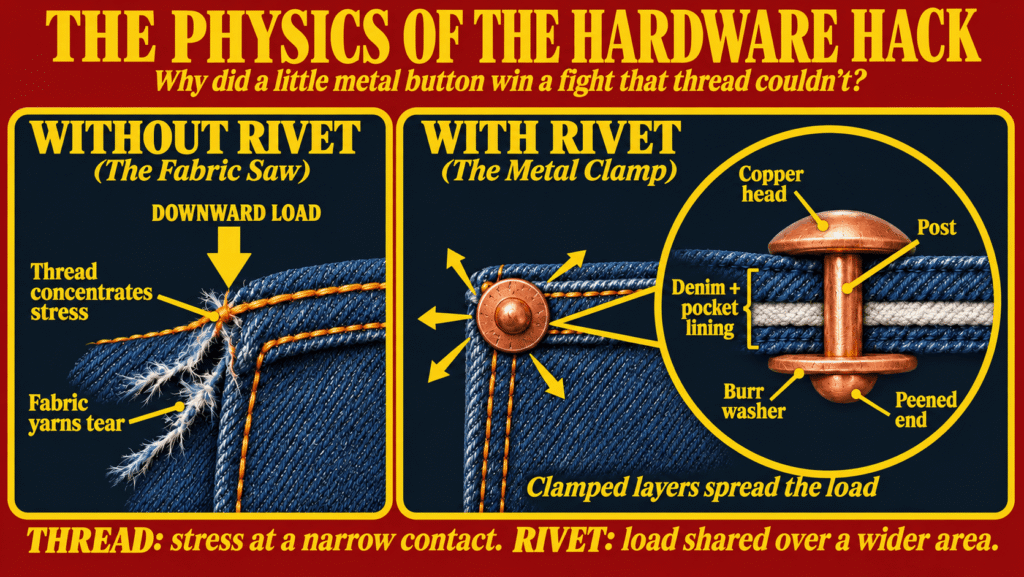
Then he looked at his workbench. Sitting right there in a wooden bowl were copper fasteners—the exact posts and washers he used to clamp together thick leather horse harnesses and canvas wagon covers.

Davis had a lightbulb moment: Why send a wimpy cotton thread to do a metal stud’s job?
He grabbed a punch, poked a hole straight through the denim pocket corner, shoved a copper post through, capped it with a washer, and hammered it flat. He riveted the front pocket corners, the watch pocket, and the base of the fly.
The woodchopper put them on, went to work, and the pockets refused to budge. The pants were practically indestructible.
Word spread through the camps faster than tavern gossip. Suddenly, miners and rail workers were banging on Davis’s door, hollering for the pants “with the metal points.”
The $68 Gamble With Levi Strauss
Davis knew he had struck gold—and for once, it didn’t involve panning in a freezing creek. But he also knew the fashion world is full of vultures. If he didn’t lock down a patent, some big-city textile mill would rip off his idea faster than a cheap seam.

The problem? A patent application cost $68. In 1872 money, that was roughly two months of rent, and Davis was flat broke.
So he wrote an urgent letter to his fabric supplier, Levi Strauss: Look, I’ve got the cure for the common rip. The men love it. Pay for the patent paperwork, and we’ll split the empire 50/50.
Strauss didn’t need to be told twice. He smelled money through the envelope.
On May 20, 1873, U.S. Patent No. 139,121 was officially granted to Jacob W. Davis and Levi Strauss & Co. for an “Improvement in Fastening Pocket-Openings.” That single piece of paper birthed the modern blue jean. Davis packed his bags, moved to San Francisco to oversee production, and Levi’s became a household name.
Not bad for a guy who just wanted to stop an angry woodchopper’s pants from splitting.

The “Campfire Catastrophe”: When Rivets Went Too Far
In their early honeymoon phase with hardware, Davis and Strauss got a little carried away. They decided that if rivets were good for the pockets, they’d be great everywhere.
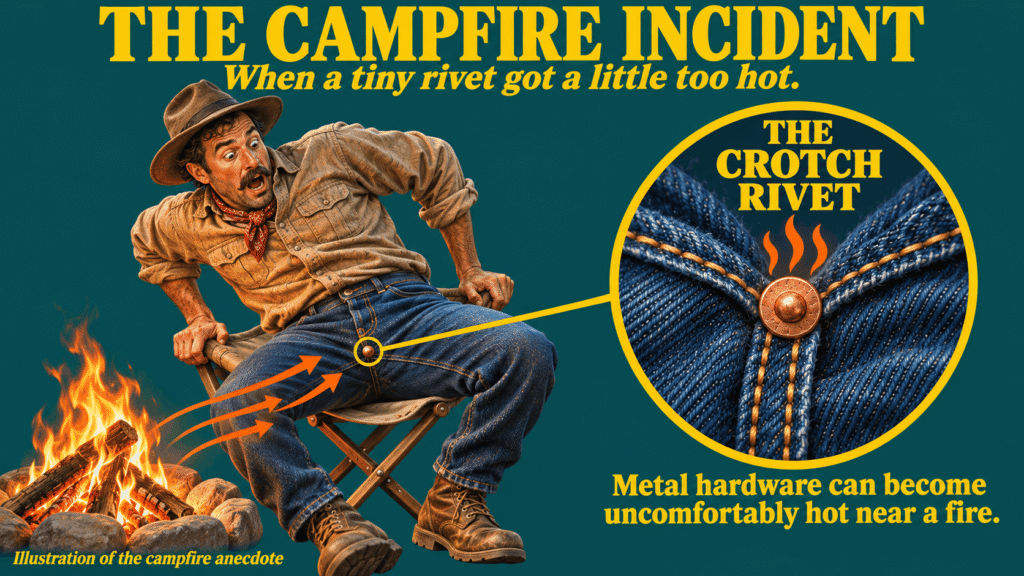
So they slapped a heavy copper rivet smack in the dead center of the pants: at the base of the crotch seam beneath the fly.
For decades, the “crotch rivet” did its job, preventing catastrophic wardrobe malfunctions while climbing saddles or leaping onto railcars. But it harbored an agonizing thermodynamic flaw.
Denim-clad cowboys and laborers slept outdoors. Naturally, after a long day in the freezing dirt, they’d squat over a glowing campfire to warm up.
If you remember high school science, you know copper is a world-class conductor of heat.

You can guess what happened next. The crotch rivet would soak up the thermal energy from the fire until it felt like a branding iron applied directly to the most delicate neighborhood on the human body. Legend has it that cowboys went hopping through the sagebrush in absolute agony.
The fiery crotch rivet stayed in production until the late 1930s or early 1940s, when Walter Haas, then-president of Levi Strauss, went on a camping trip in the High Sierra. He crouched by the fire, suffered the scorching wrath of his own product, and had the crotch rivet quietly—and permanently—struck from the blueprints the following Monday morning.
Why We Still Wear Them Today
Today, modern sewing machines can bar-tack a pocket with synthetic Kevlar-grade thread that could tow a truck. We don’t technically need rivets anymore.
Yet they haven’t budged:
- Our Gear Is Still Heavy: Miners hauled iron picks; we haul glass-and-titanium phablets and massive key rings that drag down pocket corners every single day. The rivet is still on duty.
- The Visual Soul of Denim: Take the copper rivets off a pair of jeans, and they instantly look like sterile, uninspired blue khakis. It’s the visual fingerprint of genuine Americana.
- The Snob Test: Cheap fast-fashion jeans cheat with hollow, painted aluminum snaps that pop off in the wash. Real denim purists still search for the solid, hand-hammered, raw copper burrs that bite into heavy selvedge twill—the exact same hardware that Jacob Davis hammered down on a wooden bench 150 years ago to keep a working man’s dignity intact.
So the next time you slide your phone into your pocket and feel that tiny metallic stud, show a little gratitude. That humble piece of copper is doing the heavy lifting so your pants don’t drop the ball.













+ There are no comments
Add yours