



You do not need to sell everything, resign dramatically or announce that you have “chosen freedom.” You need 30 days, a normal workload and a return ticket.
- Test everyday life abroad—not a month-long vacation wearing linen.
- Keep your job, your emergency money and your escape route home.
- Learn whether you want a new life or simply needed a decent break.
There is a point in almost every digital-nomad fantasy when common sense quietly leaves the room.
You watch someone answer emails beside a rooftop pool in Medellín. Their apartment costs less than your car payment. Breakfast appears to be $3, the weather is perfect and nobody in the video is arguing with an insurance company.
Suddenly you are ready to quit your job, sell the couch and tell your family you are moving to Colombia.
I understand the impulse. I came to this idea later in life, after enough years in America to know that adulthood can become one long relay race between bills. When the cost of merely maintaining your life keeps rising, another country can begin to look less like travel and more like an exit door.
But an exit door is not always an entrance to the right place.
Before you dismantle the life you already have, test the one you think you want. Give yourself 30 days in one city. Work your normal hours. Buy groceries. Do laundry. Get mildly bored. Find out what happens when the sunset is over and the Wi-Fi stops behaving.
This is not the glamorous approach. It is the intelligent one.
First, Decide What You Are Actually Testing

A 30-day nomad trial is not a vacation with a laptop opened twice for photographic evidence.
The question is not, “Can I have fun here?” You probably can. The real question is: Can I build an ordinary Tuesday here?
Can you wake up, work productively, eat reasonably, exercise, move around safely, handle errands and still enjoy the place after the novelty wears off? Can you do it without spending like a tourist or feeling isolated by the third week?

Write down the five things that make your current life function. Mine would include dependable internet, a quiet place to work, walkable food options, some kind of fitness routine and enough social contact that I do not begin having full conversations with the coffeemaker.
Your list may include prescription access, proximity to an airport, late-night transportation, a particular climate or work hours that overlap with your U.S. team. Those needs—not somebody else’s drone footage—should choose your test city.
Choose the Right City, Not the Most Famous One

The best first test city is rarely the cheapest city on a viral list. It is the city with the fewest complications for your life.
Start with practical filters:
- A manageable flight home
- Entry rules that clearly cover your planned stay
- Time-zone compatibility with your job
- Reliable internet in multiple locations
- Neighborhoods where daily errands can be handled easily
- Transportation you would feel comfortable using after dark
- Healthcare and pharmacies you can reasonably access
- A language situation you are prepared to navigate
Then check the current U.S. State Department destination information and Travel Advisories. Read the details, not just the number at the top. Risks can vary significantly between regions and neighborhoods inside the same country.

For a first experiment, “easy enough to function” is more useful than “wildly adventurous.” You are not auditioning for an expedition documentary. You are trying to discover whether living abroad improves your life.
Rent Like a Resident, Not Like a Tourist
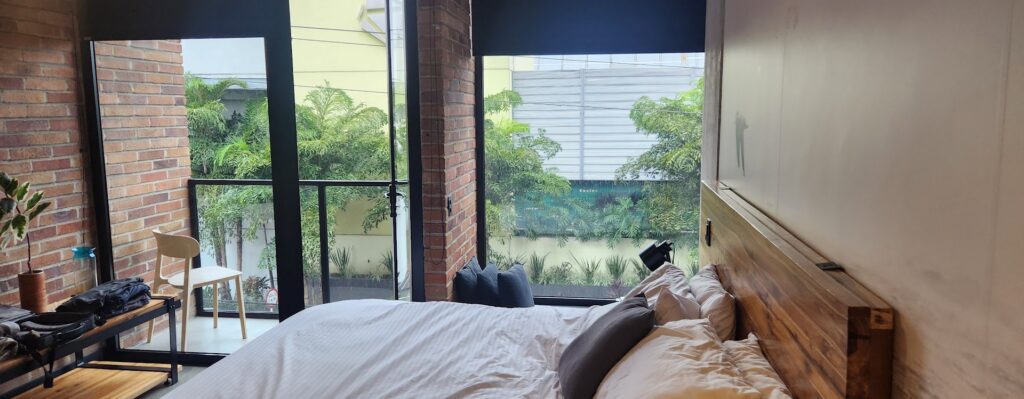
Your apartment can quietly ruin the experiment.
Stay in the polished tourist center and you may conclude that the city is expensive, loud and filled entirely with people taking photos of brunch. Stay too far outside the areas you understand and you may spend the month fighting transportation and feeling stranded.
Look for a residential neighborhood within reasonable reach of the places you will actually use: groceries, cafés, a gym, coworking, transit and a pharmacy. Read recent reviews specifically for noise, Wi-Fi, water, air conditioning, construction and nighttime surroundings. “Charming local atmosphere” has occasionally been known to mean a nightclub beneath the bedroom.
Ask the host or property manager for a recent internet-speed screenshot, but do not treat it as a sacred document. Confirm whether the connection is private to the apartment or shared with the building. Ask what happens during an outage. A nearby coworking space or reliable café should be your backup before you arrive.

If you use Airbnb, its monthly-stay rules generally begin at 28 nights, with specific payment and longer-term cancellation conditions. Read the current monthly-stay payment terms and cancellation policy before booking; a lower nightly price can come with less flexibility.
Most important, calculate the total housing cost. Include platform fees, cleaning, electricity, deposits, local taxes and anything you will need to buy after arrival. A “$700 apartment” that becomes $1,050 at checkout is not a $700 apartment. It is a math lesson.
Keep Your Normal Work Schedule

This is the rule that separates a lifestyle test from a long vacation: do your real job.
Do not take the entire month off and then decide you are wonderfully productive abroad. Of course you are. Nobody from accounting has asked you for anything.
Work the same hours you expect to keep if you move. If your company requires you to be online from 9 a.m. to 5 p.m. Eastern, see what that schedule feels like locally. In Europe, it may consume your afternoon and evening. In parts of Asia, it may turn you into a nocturnal office animal.

Before leaving, confirm that your employer permits you to work from the destination. Remote work does not automatically mean work-from-any-country. Employers may restrict international work because of cybersecurity, data handling, payroll, immigration or tax exposure. A future article in this series will examine those legal traps in detail; for this test, get written approval rather than relying on “my manager probably won’t care.”
During the month, track:
- Hours worked
- Interruptions and outages
- Video-call quality
- Energy at the beginning and end of your shift
- Whether the time difference improves or damages your life
- How often you need a second work location
Run speed tests at the apartment during your actual working hours, not only at 7 a.m. when the building is asleep. Test a video call before an important meeting. Keep mobile data available as a backup, and know how to tether your phone before you need to learn during a frozen presentation to the boss.
Test the Neighborhood in Daylight and After Dark

Online research can help you choose an area. It cannot show you how the area feels when you are carrying groceries in the rain or walking home after dinner.
During your first week, run the ordinary routes:

- Apartment to grocery store
- Apartment to coworking space or café
- Apartment to gym
- Apartment to pharmacy
- Apartment to a busy transit point
- A nighttime trip home using the transportation you would normally choose
Ask residents, building staff and established local business owners practical questions. Which streets empty out at night? Are ride-hailing pickups reliable here? Is phone theft common on crowded transit? Are taxis normally hailed, called or booked through an app?
Do not outsource all judgment to a neighborhood label. “Safe” does not mean risk-free, and “dangerous” can be too broad to be useful. Look for patterns, compare several current sources and watch how residents behave.
Before departure, use the State Department’s international travel checklist and consider enrolling in the free Smart Traveler Enrollment Program, which sends alerts from the relevant U.S. embassy or consulate.
Track the Real Budget—Every Dollar of It
If you want to know whether this life is sustainable, stop mentally converting every inexpensive lunch into proof that the entire country costs nothing.
Track all spending for 30 days:

- Housing and booking fees
- Flights and ground transportation
- Groceries
- Restaurants and delivery
- Coworking and cafés
- Mobile data
- Laundry and cleaning
- Gym or fitness classes
- Entertainment and dating
- ATM and foreign-transaction fees
- Insurance and medication
- Purchases made because your rental lacked something basic
Separate one-time trial costs from repeatable monthly costs. Your flight and airport transfer matter, but they should not be mixed invisibly into your food budget. Also separate local living from tourist entertainment. A weekend excursion is legitimate spending; just do not claim that zip-lining was a utility.
Compare the final number with your cost at home. Then ask a harder question: Did the lower cost produce a better life, or did you simply spend less while feeling less connected?
Use our companion article, The $1,500-a-Month Life: What Your Money Buys Outside America, to build your starting budget and compare survival, comfortable and “live large” spending. And if this entire idea is new to you, begin with The American Dream May Be Cheaper Outside America, the cornerstone of this series.
Keep the Money That Gets You Home
Your return-flight reserve is not spending money. It is not excursion money. It is definitely not “I met some people and we decided to rent a boat” money.
Keep enough in a separate, immediately accessible account to buy a flight home on short notice, including transportation to the airport, baggage and at least a few nights of unexpected lodging. A credit card is useful, but available credit is not the same as cash you can rely on.

Maintain a broader emergency fund for medical issues, lost equipment, a sudden housing problem or interrupted income. The Consumer Financial Protection Bureau’s emergency-fund guide offers a useful starting point: emergency savings are for unplanned expenses, not routine monthly spending.
Also make copies of your passport, insurance information, prescriptions and important contact details. Keep secure digital copies and leave access instructions with someone you trust.
The goal is not to expect disaster. The goal is to prevent one bad week from becoming a financial hostage situation.
Make Week Three Deliberately Boring

This may be the most important part of the test.
For one week, stop behaving like a visitor. No major tours. No constant restaurant hopping. No treating every evening like your final night in town.

Cook. Work. Exercise. Do laundry. Sit in the same café twice. Spend one evening at home. Take a walk without turning it into content.
Vacation energy can make almost any place feel perfect for ten days. Routine reveals whether you actually like your life there.
Pay attention to what happens when nothing exciting is scheduled. Do you feel peaceful or trapped? Can you form the beginnings of a community? Do you like the version of yourself that appears when you are no longer rushing from one attraction to another?
The dream is not to remain permanently entertained. The dream is to build a life you do not constantly need to escape.
The 30-Day Stay-or-Go-Home Scorecard
On your final day, score each category from 1 to 5:
Category 1 3 5 Workability Frequent disruptions Manageable with compromises As productive as—or better than—home Affordability More expensive than expected Some meaningful savings Clearly sustainable with room to breathe Housing Uncomfortable or impractical Acceptable A place you could genuinely live Daily mobility Stressful or limiting Workable Easy and natural Safety and confidence Frequently uneasy Situationally comfortable Consistently aware and capable Health and routine Habits deteriorated Mixed Healthier, calmer routine Social connection Isolated Occasional connection Real potential for community Enjoyment after novelty Wanted to leave Unsure Still wanted to stay Time-zone fit Damaged work or sleep Tolerable Supported the life you want Desire to return No Maybe Already planning it
Add the scores out of 50:
- 41–50: You may have found a serious candidate for a longer stay.
- 31–40: Promising, but identify the compromises before committing.
- 21–30: You may like the city more as a visitor than as a resident.
- 10–20: Go home with useful information, not embarrassment.
A low score is not failure. Discovering that you prefer a stable home base, shorter trips or a different city is exactly what the experiment was designed to reveal.
You Are Allowed to Come Home
There is a strange pressure in digital-nomad culture to describe every move abroad as liberation. Sometimes it is. Sometimes you miss your people, your routines, your bed and the ability to understand every conversation happening around you.
Coming home does not mean you lacked courage. Staying abroad does not automatically mean you found freedom.
At this stage of life, I am less interested in looking adventurous than in building something sustainable. I do not need to prove that I can abandon everything. I need to know whether another way of living gives me more time, more financial breathing room and more control over my days.
Thirty honest days can answer that better than a thousand beautiful videos.
Keep the job. Keep the return ticket. Keep enough money to change your mind.
Then go find out whether the life you keep imagining can survive an ordinary Tuesday.
Next in the series: Seven Businesses You Can Run From Your Phone While Traveling the World.
Editorial note: Entry rules, remote-work permissions, safety conditions and tax consequences can change. Verify current requirements with the destination’s official authorities and qualified legal or tax professionals before traveling or working abroad.
















+ There are no comments
Add yours