
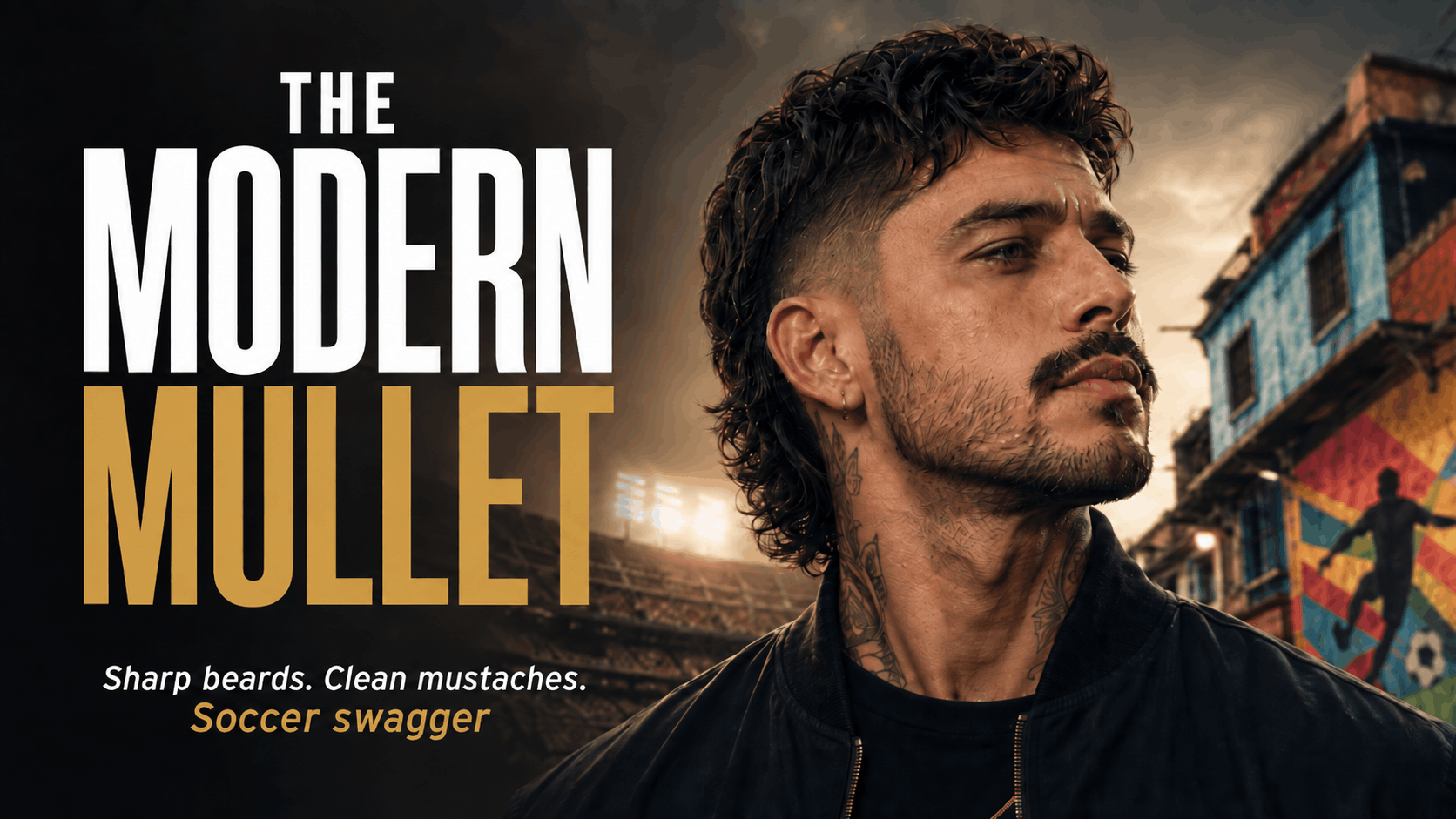


- Find out which modern mullet fits your face and style.
- Learn the difference between burst fade, taper fade, French crop, and wolf cut mullets.
- See how to pair your mullet with the right beard or mustache.
There was a time when the mullet was less a haircut and more a public warning. Business in the front, party in the back, confusion everywhere. It belonged to rock drummers, wrestlers, uncles with Camaros, and men who thought cologne counted as a shower.
But somehow, the mullet has returned.
And this time, it has better product, better fades, and a passport.
The comeback did not just crawl out of an American dive bar or a Brooklyn barbershop trying too hard. A lot of the modern mullet energy was already alive in Latin America, especially in soccer culture, where hair has always been part of the performance. Long before the rest of the world decided the mullet was “fashion,” futboleros were already treating the back of the head like prime real estate. A 2011 football-culture photo essay, “The Mullets of Medellín,” captured Colombian soccer players wearing the short-front, long-back look years before the mainstream menswear crowd started pretending they invented it.
That is the thing about Latin American soccer style: it rarely asks permission. It shows up with confidence, gel, a fade, a goal celebration, and a grandmother somewhere saying, “Mijo, you look handsome,” even if the rest of us need ten minutes to process the haircut.
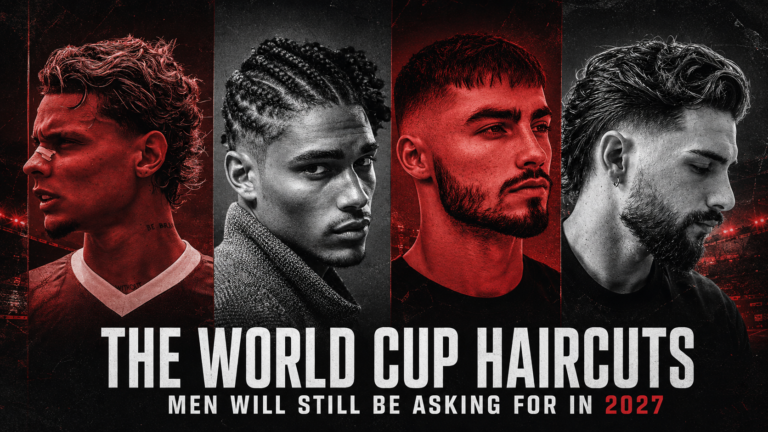
And now, during the 2026 World Cup, you can see the influence everywhere. Soccer has once again become the world’s biggest grooming runway. FIFA itself has celebrated World Cup hair as part of the tournament’s visual history, noting everything from mullets and mohawks to ponytails, rat tails, color, and other unforgettable player hairstyles. GQ has also pointed out that the 2026 World Cup has already turned player hair into a trend conversation, with frosted tips and bold modern finishes showing up across teams from Ecuador, Spain, Curaçao, Canada, Senegal, and Tunisia.
In other words, the pitch is not just where soccer players prove who has the best first touch. It is where they prove who has the bravest barber.

The Modern Mullet: Less Monster Truck, More Midfielder With Endorsements
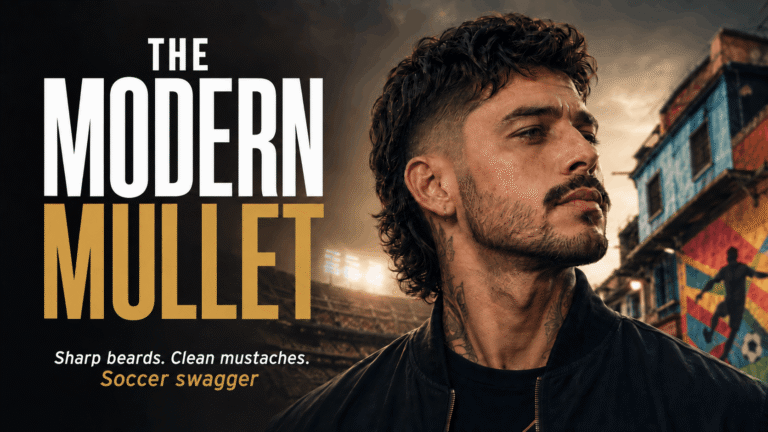
The modern mullet works because it is not the old mullet. The old mullet looked like it happened after three beers and a dare. The new mullet is shaped. It is faded. It is textured. It has structure.
The best version has a cleaner side profile, controlled length in the back, movement on top, and enough shape around the ears to let people know you did not cut it yourself during a power outage.
This is why soccer helped bring it back. Soccer players understand balance. The front has to look sharp for the cameras. The back has to move when they sprint past defenders. The whole thing has to look intentional while surviving sweat, humidity, headers, national pressure, and 80,000 people screaming like rent is due.
That is not just a haircut. That is engineering.
The modern mullet says, “I have personality.” The Latin American soccer version says, “I have personality, footwork, and a cousin who knows the best barber in town.”
The Burst Fade Mullet: The Loud One
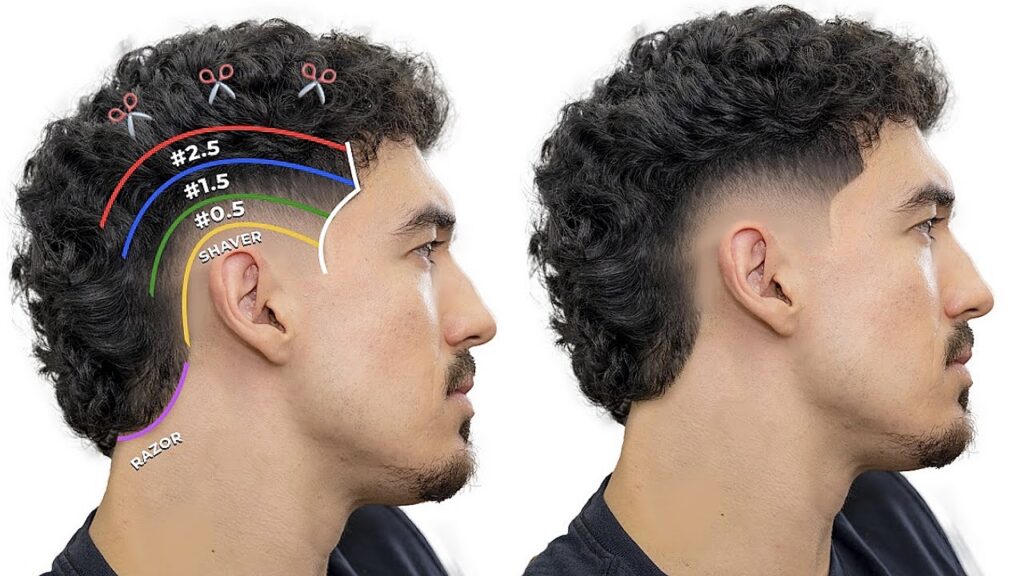
The burst fade mullet is probably the most athletic-looking version of the modern mullet.
Instead of fading the whole side evenly, the fade “bursts” around the ear in a curved shape, leaving more weight toward the back. That gives the haircut a sharp, aggressive profile while still keeping the mullet’s signature length behind the head.
This is the version that feels closest to soccer culture. It has speed. It has attitude. It looks like it belongs on a winger who just nutmegged someone and pretended not to notice.
The burst fade mullet works especially well with curly, wavy, or thick hair because the back can carry texture without looking flat. It also pairs well with a sharp beard or beardstache because both the haircut and facial hair have strong lines.
But be warned: this is not a shy haircut.
A burst fade mullet does not whisper. It walks into the room and asks who is marking the far post.
The Taper Fade Mullet: The Clean One
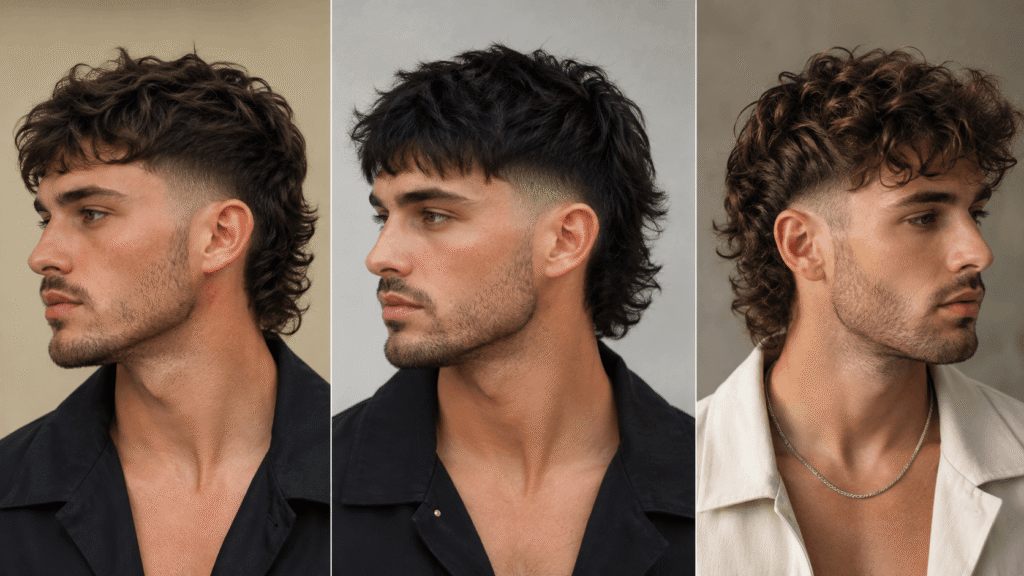
The taper fade mullet is the safest entry point for men who want the mullet comeback without looking like they are auditioning for a regional wrestling documentary.
Instead of taking the sides extremely short, the taper fade cleans up the edges around the temples, ears, and neckline while keeping the overall shape softer. You still get the mullet’s movement in the back, but the haircut feels more controlled.
This is the version for men who want style without frightening their office.
It works with casual clothes, streetwear, soccer jerseys, leather jackets, and even some more polished looks. The taper fade mullet says, “I have personality,” but it does not say, “I just quit my job to start a band in a storage unit.”
If you are trying the mullet for the first time, start here. It gives you the shape without the full emotional commitment.
The French Crop Mullet: The Fashion One
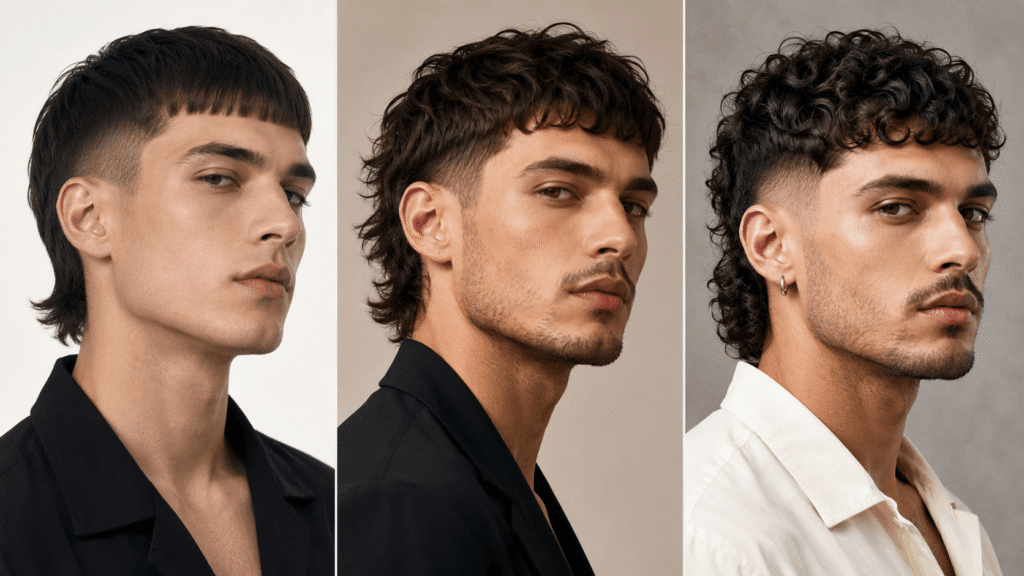
The French crop mullet is where things get interesting.
A French crop usually has a short, textured top with a forward fringe. When you add mullet length in the back, you get a haircut that feels European, editorial, and slightly dangerous in a very controlled way.
This is not the beachy mullet. This is not the country-rock mullet. This is the fashion mullet.
The front gives structure. The fringe frames the face. The back adds movement. The result is a haircut that looks intentional from every angle.
The French crop mullet works especially well for men who want something stylish but not messy. It can look great with a closely shaped beard, a thin mustache, or a clean beardstache. The contrast is the whole point: sharp front, textured back, clean facial hair.
It is a haircut that says, “I read the menu before ordering,” but also, “I might still choose the weirdest thing on it.”
The Wolf Cut Mullet: The Wild One
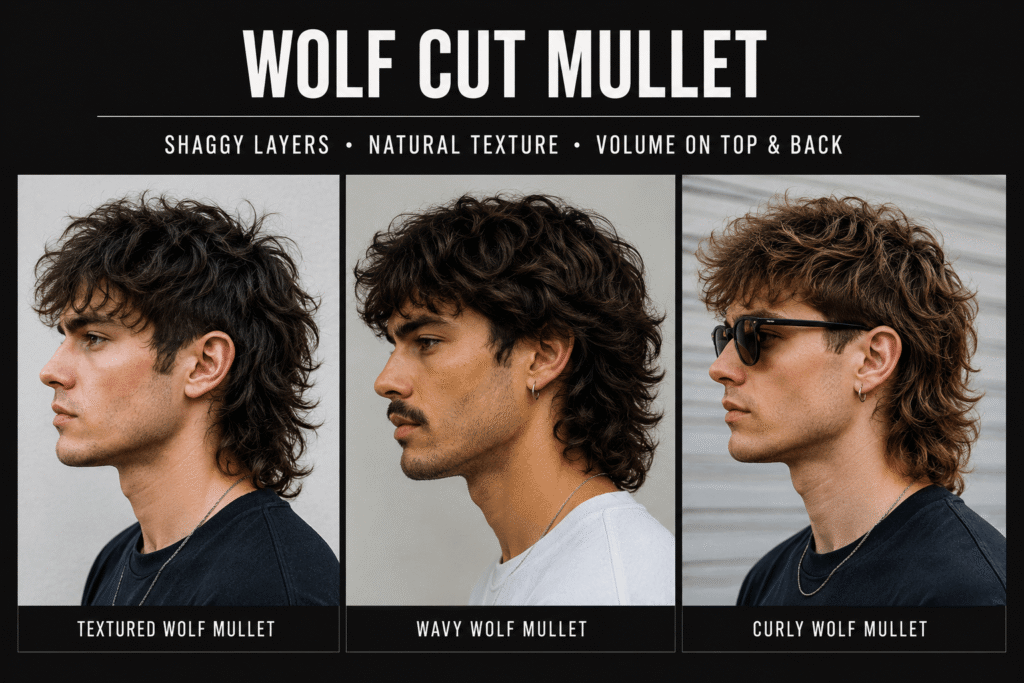
The wolf cut mullet is the looser, messier, more rebellious cousin.
It blends the shag and the mullet, creating layers, volume, and movement. The top is fuller. The back is longer. The whole thing has a rock-and-roll feel without being trapped in the 1980s.
This is the version for men with great natural texture. Waves, curls, thick hair, and even slightly unruly hair can work beautifully with a wolf cut mullet. The point is not to make it perfect. The point is to make it look alive.
But there is a difference between “styled messy” and “I woke up in a parking lot.”
The wolf cut mullet needs shape. It needs layers. It needs a barber who understands movement. Otherwise, it can collapse into chaos very quickly.
Done right, it gives you that soccer-meets-streetwear-meets-rockstar energy. Done wrong, it gives you “camp counselor who lost the van keys.”

Latin America Never Really Let It Die
For a lot of American men, the mullet feels like a comeback. For parts of Latin America, it feels more like a continuation. Soccer fields, neighborhood clubs, barbershops, and street style kept versions of the look alive while the rest of the world was busy pretending every man needed the same fade and the same sad little side part.
Latin American soccer style has always had drama. Carlos Valderrama’s giant blond curls became almost as iconic as his Colombian playmaking. Neymar made mohawks, mullet hybrids, bleached tops, and experimental cuts feel like part of the show. Argentine, Brazilian, Colombian, Mexican, and Uruguayan players have long understood that hair is not just grooming. It is identity. It is swagger. It is a flag without fabric.
The 2026 World Cup has only amplified that. Every close-up before a penalty kick is also a grooming commercial. Every celebration becomes a style reference. Every young man watching at home sees the haircut, pauses the screen, and thinks, “Yeah, my barber can do that.”
Sometimes the barber can.
Sometimes the barber should not.
But the influence is real.

The Beard Is Getting Sharper
While hair is getting looser, facial hair is getting more disciplined.
The modern beard is not just grown. It is managed. It is shaped. It is lined up like it has a meeting at 10 and a rooftop reservation at 8.
A closely shaped beard works perfectly with the modern mullet because it creates balance. The hair can have movement and attitude, but the beard needs to bring structure. If the mullet says, “I might dance on a table,” the beard says, “But I also paid the bill.”
The strongest look right now is the short boxed beard: full enough to frame the jaw, tight enough to look intentional. It gives the face definition without making you look like you are hiding from a federal subpoena.
The cheek line should be clean. The neckline should be controlled. The beard should make your face look better, not like it is slowly taking over your shirt collar.

The Mustache Has Entered Its Main Character Era
The mustache has returned too, and not quietly.
For years, the mustache was trapped between police officer, 1970s dad, bartender, villain, and guy who says “ladies” too much. But now it has range. It can be stylish. It can be masculine. It can be funny without being a joke.
The beardstache — a stronger mustache paired with shorter stubble or a trimmed beard — is one of the easiest ways to add character without going full costume. It works especially well with a modern mullet because both have a little attitude. Together, they say, “I know exactly what I’m doing,” even if you are still figuring out your password to the gas company website.
The key is control. Trim the lip line. Keep the edges neat. Do not let the mustache become a soup net. A great mustache adds presence. A neglected mustache makes people wonder if you need a napkin.
The Winning Formula: Controlled Chaos
The new men’s grooming look is all about contrast.
The hair can be expressive. The beard should be sharp.
The mullet can move. The mustache should be shaped.
The whole look should feel stylish and a little dangerous — not like you lost a bet at a bachelor party in Tampa.
That is why the Latin American soccer influence matters. It brings confidence. It brings movement. It brings that feeling that grooming does not have to be boring to be masculine.
A man can have a mullet and still look polished. He can have a mustache and not look like he sells suspicious supplements. He can have a beard and not look like he is preparing to live in the woods.
The modern version is not sloppy. It is controlled chaos.
What to Ask Your Barber For
Do not walk into a barbershop and simply say, “Give me a mullet.”
That is how tragedies begin.
Ask for a modern mullet, taper mullet, or mini mullet with textured length in the back, cleaner sides, and enough shape on top to style naturally. Bring a photo. Preferably not one from 1986. Ask for something influenced by soccer style, but cleaned up for real life.
If you want the World Cup energy without looking like you are about to argue with a referee, ask for a soft mullet with a low taper. It gives movement without going full stadium chaos.
For the beard, ask for a short boxed shape, defined cheek line, and natural neckline. For the mustache, ask for a clean lip line and slight blending into the beard or stubble.
This is not the time to be vague. Barbers are talented, but they are not psychics. “Make me look cool” is not a grooming strategy. It is a cry for help.
Who Can Pull It Off?
Almost any man can pull off a version of this look, but not every man should choose the same level of drama.
If you work in a conservative office, go with the mini mullet and short boxed beard. If you are in fashion, media, nightlife, music, sports, or any industry where people use the word “energy” during meetings, you can push it further.
If you are newly single and suddenly “rebranding,” proceed carefully. The mullet can be powerful, but it cannot fix your relationship history.
Face shape matters too. Round faces benefit from height and sharper beard lines. Longer faces should avoid too much vertical volume. Strong jaws look great with tight beards. Softer jawlines can use a shaped beard to create definition.
And if your beard grows patchy, do not force it. A beardstache or clean mustache with stubble can still give you character without making your face audition for a forest it was never meant to grow.
The Maintenance Reality
Here is the part men hate: the effortless look is rarely effortless.
The modern mullet needs shaping every few weeks. The beard needs regular cleanup. The mustache needs attention before it starts interfering with sandwiches.
This is not high-maintenance grooming. It is medium-maintenance masculinity. There is a difference.
You need a good barber, a trimmer, a styling product that does not make your hair feel like a plastic helmet, and the emotional maturity to admit when your neckline has become a problem.
Final Verdict
The return of the mullet, shaped beard, and mustache is not just nostalgia. It is men wanting style with personality again.
The clean fade had a great run. The buzz cut will always have its place. The corporate side part is still sitting in a conference room somewhere asking if we can circle back.
But the modern man wants a little more movement. A little more attitude. A little more World Cup swagger.
And Latin America helped remind everybody that hair can be part of the performance. The mullet did not just come back. It came back with a fade, a shaped beard, a mustache, and a celebration run toward the corner flag.
So yes, the mullet is back.
But this time, it has a barber, a game plan, and possibly a yellow card.












+ There are no comments
Add yours